





Beyond the grading panel: objective skin assessment with VivoSight OCT

Cosmetic product development has long relied on expert grading panels, consumer self-assessment, and photography as the primary tools for measuring treatment effects. These methods have served the industry, but they carry inherent limitations: subjectivity between assessors, sensitivity to lighting and angle, and the fundamental inability to capture structural changes beneath the skin surface.
VivoSight OCT addresses all three. It provides fast, non-invasive, objective skin assessment. Three-dimensional imaging of skin structure and microvasculature — and, through automated analysis software, delivers quantitative metrics that are repeatable across time points and reproducible across sites. With an imaging depth of more than 1mm and a 6×6mm field of view, VivoSight captures the full depth of the dermis and a meaningful skin area in a single 15-second scan. For R&D teams and regulatory affairs managers building the objective evidence base behind product claims, that combination is genuinely difficult to replicate by other non-invasive means.
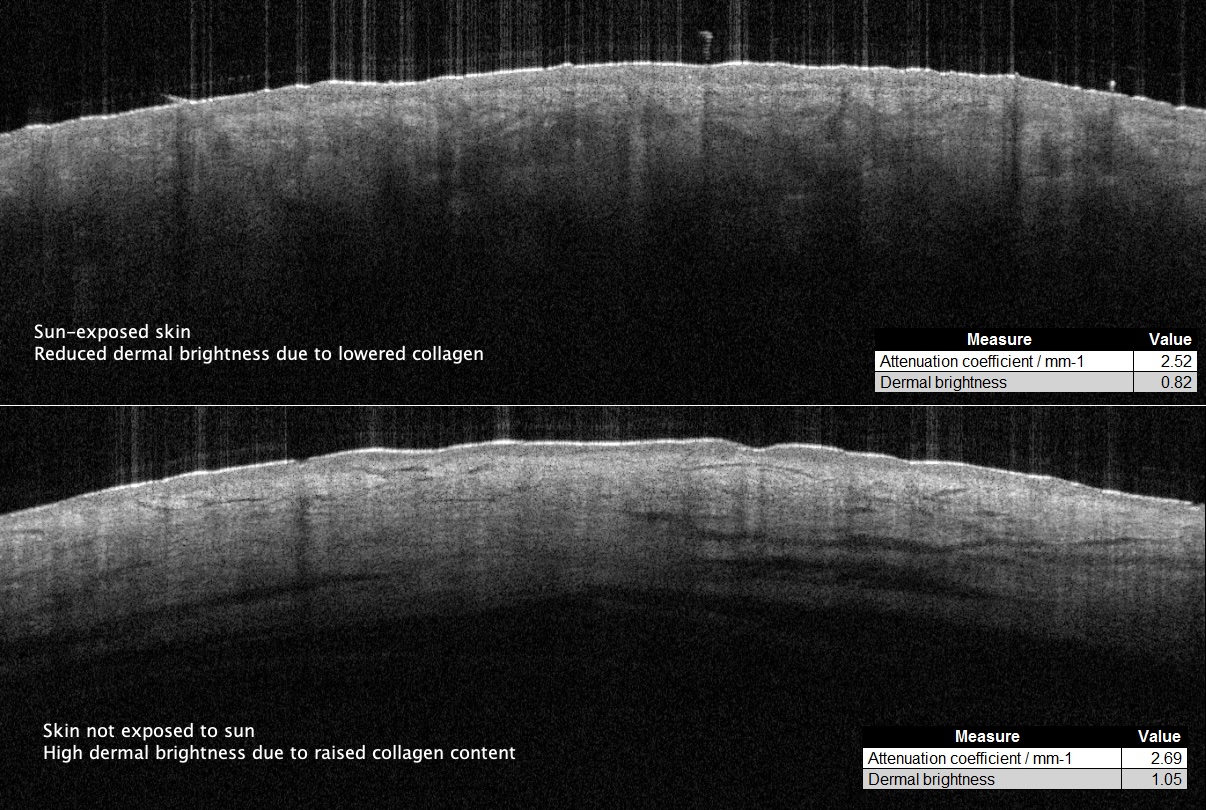
Leading Endpoint: Dermal Brightness as a Collagen proxy
Dermal brightness — the OCT signal intensity within the dermis — is the most clinically and commercially significant measurement VivoSight OCT enables for cosmetics research. Organised, intact dermal collagen produces a characteristic high-signal pattern on VivoSight OCT scans. As collagen degrades under UV exposure, intrinsic ageing, or inflammatory processes, this signal changes in measurable, quantifiable ways.
The result is a non-invasive, in vivo proxy for collagen content and organisation — one of the primary targets of anti-ageing and skin repair interventions — obtainable without biopsy, in a 15-second scan, and trackable longitudinally within the same subject. No other commercially available non-invasive imaging system with comparable imaging depth and field of view currently offers this capability.
This makes dermal brightness an endpoint of direct relevance to both internal R&D decision-making and external claims substantiation: it is quantitative, repeatable, and grounded in a peer-reviewed methodology established across more than 50 published studies using VivoSight OCT.
Additional VivoSight OCT endpoints
VivoSight Dx Pro, with the additional D-OCT and VivoTools skin analysis options, provides three further quantitative endpoints from the same 15 or 30 second scan:
- Epidermal thickness: averaged across the full 6×6mm scan area. Provides a sensitive measure of skin condition changes — including treatment-induced epidermal normalisation — that surface photography cannot capture.
- Skin surface roughness: quantified as average roughness (Ra) and peak-to-trough (Rz), directly comparable to profilometry outputs, obtained non-invasively in vivo.
- Vascular density and vessel diameter by depth: enabling characterisation of the skin’s microvascular network and changes in response to treatment, age, or UV exposure.
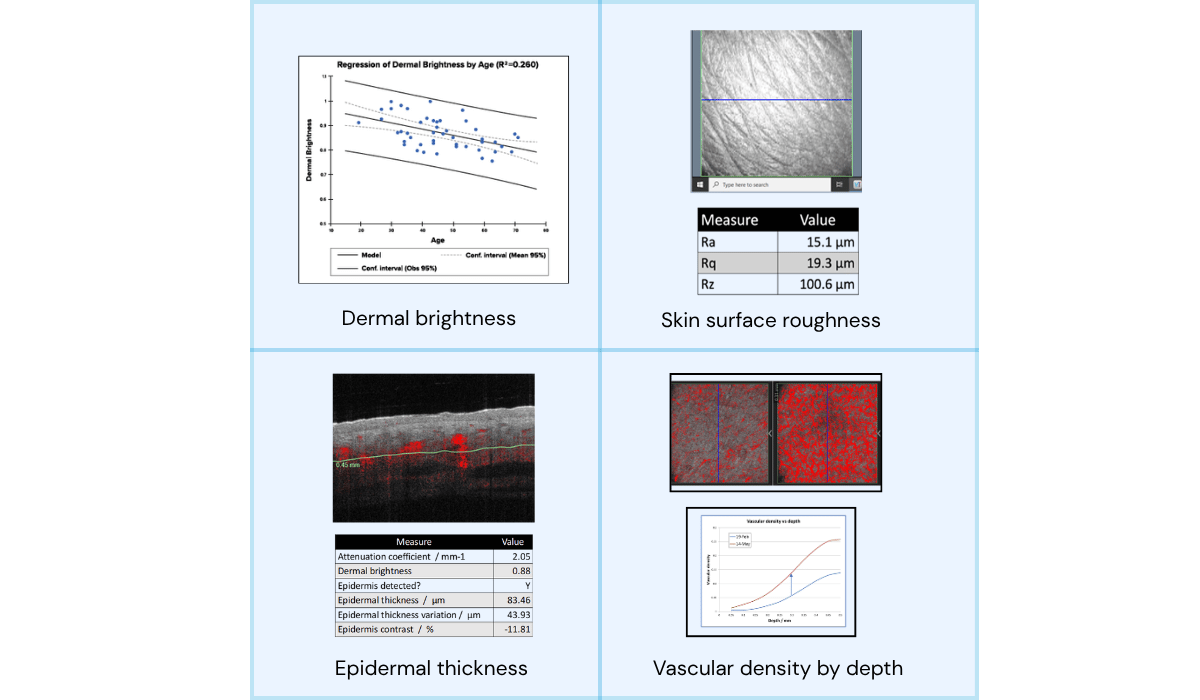
VivoTools OCT measurement suite
The evidence base
More than 56 peer-reviewed publications have used VivoSight OCT in cosmetics and skin health research, covering anti-ageing treatments, topical moisturisers, retinoids, photoprotection, energy-based aesthetic procedures, and skin barrier assessment.
A standardisation framework for VivoSight OCT parameters in cosmetic science — ensuring reproducible endpoints across studies — was published by Ciardo et al. in Experimental Dermatology (2021), providing a methodology base for investigators designing new efficacy programmes. Assessment of topical retinoid effects using VivoSight OCT in subjects with moderate-to-severe photo-damage was demonstrated by Goberdhan et al. (JAAD, 2021), showing measurable changes in skin structure detectable non-invasively.
CRO adoption reflects this trend. SGS Cosmetics & Hygiene uses VivoSight OCT as part of their objective measurement toolkit. As their Global Scientific Advisor, Lily Jiang PhD, has noted: “VivoSight OCT provides a fast and straightforward way of accurately monitoring key measures such as epidermal thickness, skin roughness and blood vessel density with a simple 15-second scan.”
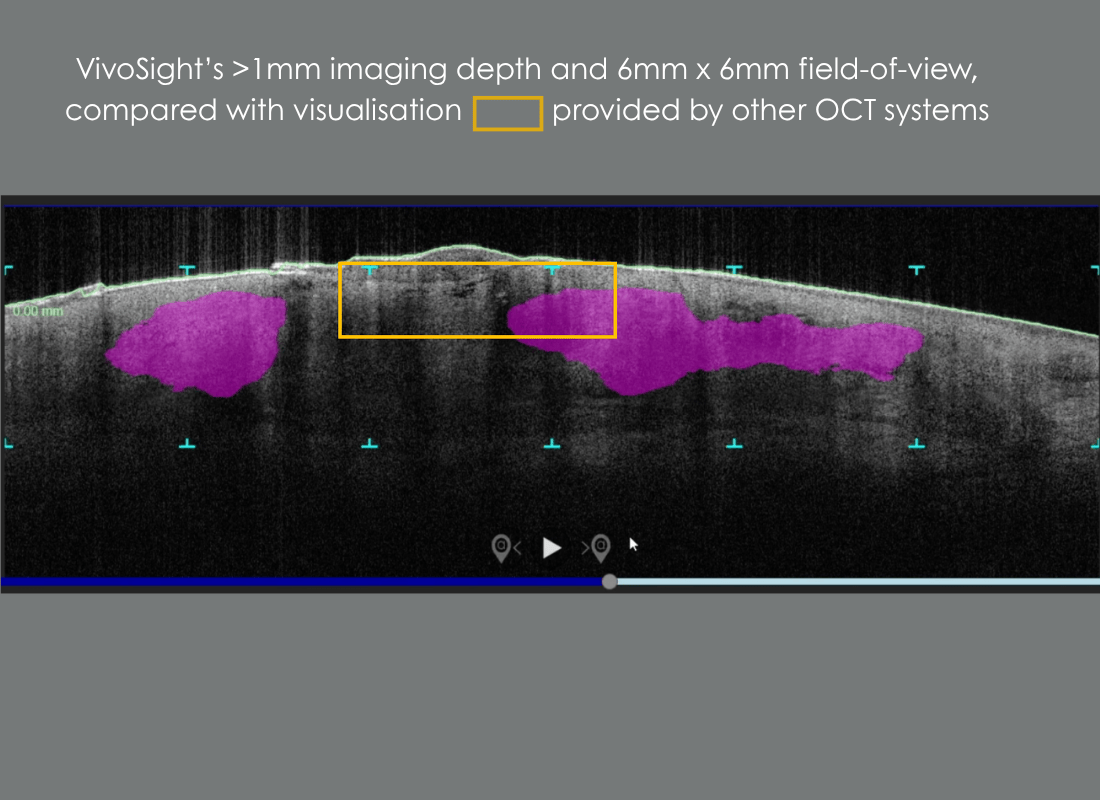
VivoSight’s >1mm imaging depth and 6×6mm FOV are prerequisites for full dermal characterisation.
Why this matters for claims and regulatory submissions
With VivoSight OCT-derived metrics — particularly where the measurement protocol is standardised, the study is appropriately powered, and the results are peer-reviewed — represent a credible, defensible evidence base for claims substantiation. Quantitative outputs are statistician-ready and directly comparable across time points, without the variability inherent in expert grading.
References
VivoSight measurements are for investigational use only.
Next steps:
Request a VivoSight OCT research demonstration
See how VivoSight OCT integrates into your CRO or research workflow – schedule a demonstration for your team.
Browse 800+ peer-reviewed VivoSight OCT publications across cosmetics, NMSC, drug delivery, and more